
Professional Language Solutions
Our Service
Audio says a lot. Written records say it permanently. When you need spoken content converted into something you can file, submit, reference, or publish — accuracy isn’t optional, and neither is getting the terminology right.
About This Service
Someone records a deposition or clinical consultation, runs it through an automated tool, and gets back something that looks fine — until a medical term is wrong, a speaker misattributed, or key sentences dropped due to background noise.
At Elephanta, every transcription is handled by a trained human — not an automated pass. They manage accents, overlapping speakers, and poor audio. A second reviewer checks before delivery.
Specializations
Each type of content comes with its own requirements — terminology, formatting, confidentiality standards, and the level of precision the end use demands. Here’s how we handle each one.
General transcription covers the wide range of business and everyday content that needs to be in written form — team meetings, podcast episodes, webinars, interviews, training sessions, corporate recordings. The audio is usually reasonably clear, the subject matter is accessible, and the main requirements are accuracy, clean formatting, and fast turnaround.
We handle these efficiently and return them in the format that works for you — plain text, Word document, PDF, timestamped transcript, or speaker-labelled format. For businesses that produce a lot of recorded content — internal meetings, client calls, online events — we can set up a recurring workflow so transcription becomes a routine part of your process rather than something you sort out each time.

Legal transcription has almost no margin for error. Court hearings, depositions, arbitration proceedings, legal dictations, attorney recordings — every word in these documents can matter. A missed phrase, a misattributed speaker, a term that got transcribed close-but-not-quite is a problem in a way it simply isn’t in other contexts.
Our legal transcriptionists have direct experience with legal proceedings and the specific formatting conventions that courts and law firms require. We produce verbatim transcripts — meaning every word, every pause where noted, every interruption — accurately attributed to the right speaker, with timestamps where needed. Confidentiality on legal files is handled under strict NDA and secure file transfer protocols from the moment a file is shared with us.

Medical transcription is its own discipline. The terminology is dense, highly specific, and doesn’t forgive approximations — a transcriptionist who doesn’t know the difference between clinical terms will make errors that look plausible on the page but are medically wrong. Doctor’s notes, patient consultation recordings, surgical reports, clinical trial audio, discharge summaries — these need people who understand what they’re listening to, not just people who type quickly.
Our medical transcriptionists have healthcare and pharmaceutical backgrounds. They know the terminology, they know the standard formats different medical documents use, and they handle every file with the level of confidentiality that clinical content requires. We work to HIPAA-compliant data handling standards, and patient information is treated with the same care you’d expect from a clinical environment.

Media transcription is less about formal accuracy requirements and more about volume, speed, and output format. TV episodes, documentaries, news segments, YouTube content, corporate video — these need transcripts that are either used internally for editing and archiving, or formatted into subtitles and closed captions that sync with the visual content.
We handle both. For internal or archiving purposes, we deliver clean, readable transcripts with speaker labels and timestamps. For subtitle and caption work, we format the output to meet broadcast standards and video platform requirements — correct line length, accurate timing, clean display. For multilingual content, we can transcribe in the source language and produce subtitles in a second language simultaneously.

Research transcription has its own set of requirements that general transcription services often underestimate. Focus group recordings with multiple participants speaking over each other. In-depth interviews where the interviewee’s exact phrasing matters for qualitative analysis. Lectures and conference presentations where technical or disciplinary terminology is dense and specific. These aren’t hard to transcribe badly — they’re hard to transcribe well.
We provide speaker-labelled, timestamped transcripts formatted to academic standards, with consistent attribution and verbatim accuracy where the research requires it. For qualitative researchers in particular, the precision of the transcript directly affects the quality of the analysis — and we treat it accordingly. We also work with university and institutional NDAs for research that involves confidential participant data.

Multilingual transcription is a step beyond standard transcription — you have audio or video in a language other than English, and you need either a transcript in that source language, a transcript in English, or both. Each of those is a different task, and combining them into one workflow without losing accuracy at either stage is where most providers run into trouble.
We handle the full process in-house. The audio is transcribed by a native speaker of the source language — not run through translation software and then cleaned up. If you need the transcript translated as well, that goes to a specialist linguist who works from the transcribed text, not the audio. The result is a transcript and translation that are both accurate independently, not two outputs that inherited errors from each other.
Why Elephanta
Accuracy in transcription isn’t something you can approximate — either the transcript reflects what was said or it doesn’t. Here’s what we do to make sure it does.
Languages
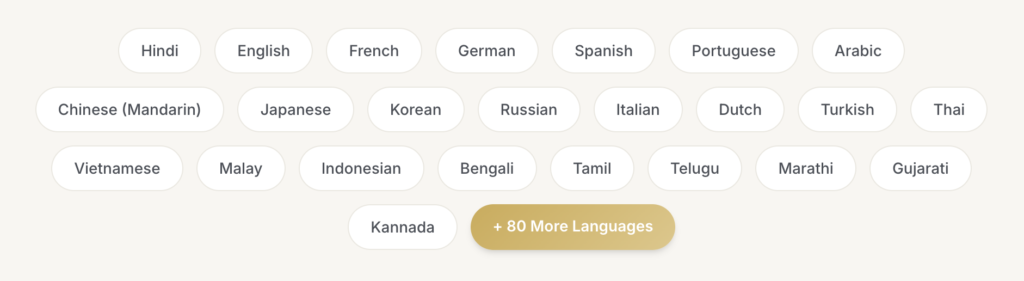
We transcribe audio and video across all major European, Asian, Middle Eastern, and Indian languages — including Hindi, Tamil, Bengali, Marathi, Gujarati, Arabic, Mandarin, Japanese, French, German, Spanish, Portuguese, and many more. For multilingual recordings with mixed-language audio, we handle each language stream separately and deliver clearly attributed, properly formatted output.
If you have a language pair you’re unsure about, ask directly. We’ll tell you what coverage we have and who would be handling it.
FAQs
Most of them — MP3, MP4, WAV, MOV, AVI, WMV, M4A, FLAC, and other common formats. If your file is in a format you’re not sure about, just send it across and we’ll confirm. For large files we provide a secure upload link rather than asking you to email them.
Both, and the choice depends on what you’re using the transcript for. Verbatim captures everything — filler words, false starts, pauses, non-verbal sounds like laughter or coughing. Clean read removes those for a polished, readable document. Legal and research transcription usually requires verbatim. Corporate and media content is usually better served by clean read. Tell us what the transcript is for and we’ll recommend the right approach.
Yes — and this is one of the areas where human transcription genuinely outperforms automated tools. Our transcriptionists are trained to handle overlapping speakers, regional accents, technical jargon, and audio that isn’t perfectly clean. Each speaker gets a clear label, and if a section is genuinely inaudible rather than just difficult, we flag it honestly rather than fill it in with a guess.
Yes. We can include timestamps at set intervals, on every speaker change, or both — depending on what the transcript is for. Speaker labels are standard on any multi-speaker recording. If you have a specific format requirement — a court format, a research template, a broadcast caption style — tell us before we start and we’ll match it.
Yes. We offer a combined transcription and translation service — the audio is transcribed in the source language first, then that transcript goes to a specialist linguist for translation into your target language. Both stages are handled in-house, which means errors don’t carry across from one stage to the other. The final output is an accurate transcript in the source language and an accurate translation — not a translation of an automated transcript.
Send us the file and tell us what you need — language, format, turnaround, any specific requirements. We’ll come back with a clear quote and realistic timeline before anything starts.
No automated responses. No vague estimates. Just a straightforward answer from someone who’s actually looked at your project.
Elephanta Consultancy is a trusted partner delivering innovative solutions with a focus on quality, efficiency, and long-term value. We combine expertise and modern strategies to help businesses grow, adapt, and succeed in a competitive digital landscape.
© 2026 Elephanta Consultancy. All rights reserved. Developed By Asharp Infotech